August 18, 2026 • Ibexcode
Machine Learning and Human Learning: Surprisingly Similar Problems
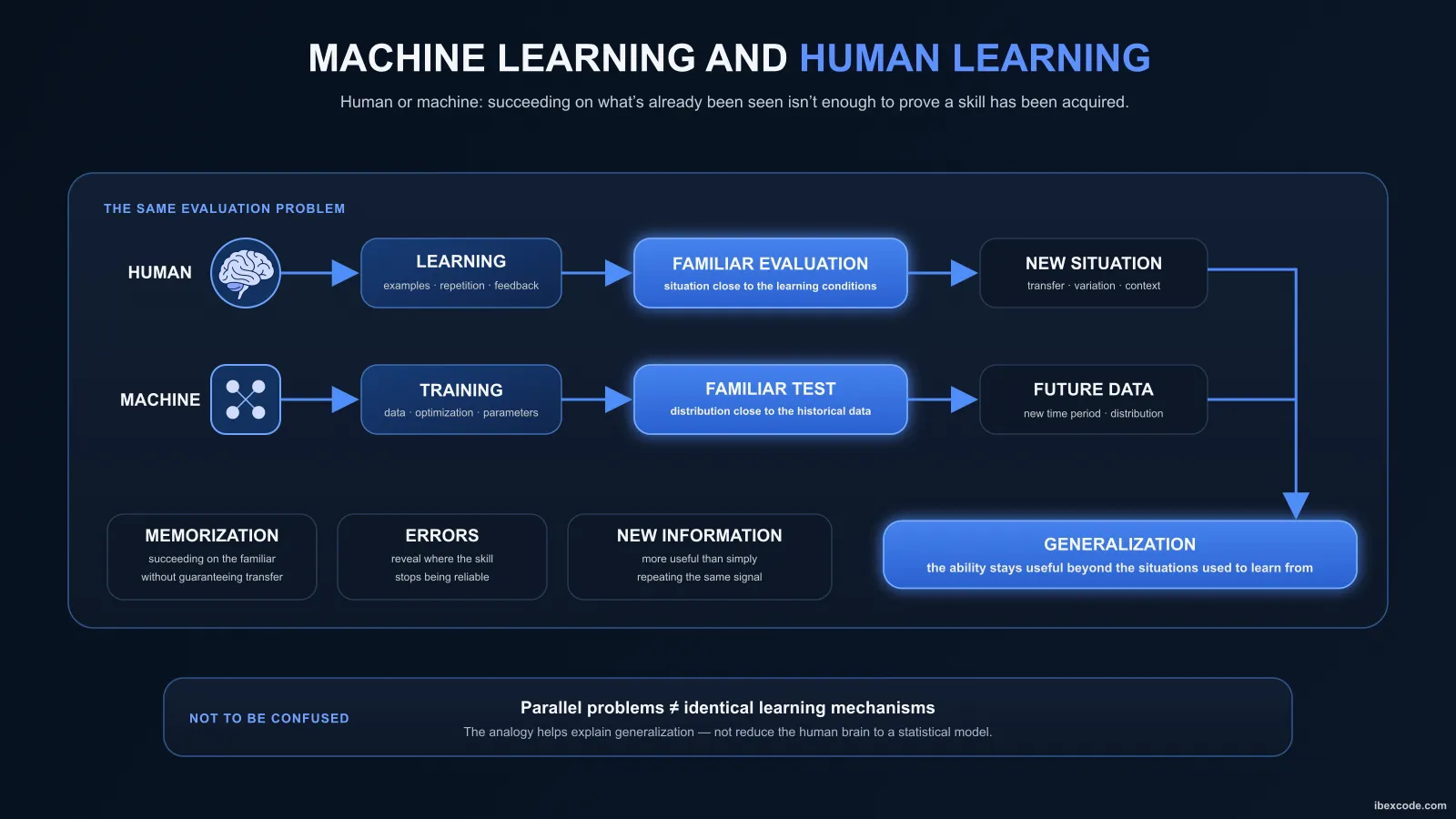
A Machine Learning model and a human obviously don’t learn the same way.
An artificial neural network isn’t a reproduction of the brain, a loss function isn’t the equivalent of a school grade, and gradient descent doesn’t describe how human learning works.
And yet, once you stop comparing their internal mechanisms and start looking at the problems learning itself poses, some parallels become genuinely interesting.
- How do you tell memorization apart from understanding?
- How do you know a skill you’ve acquired will still hold up in a new situation?
- What can you actually conclude from a good result on an evaluation?
- Is it useful to pile on more examples if they all carry the same information?
- What do errors tell us about what was actually learned?
These questions show up in different forms in human learning and in Machine Learning. Yet they lead to the same general idea:
Succeeding on what was used to learn isn’t enough to prove you can succeed on what you haven’t encountered yet.
1. Learning isn’t memorizing
Picture a student preparing for an exam by drilling the exact same exercises over and over.
After enough repetitions, they can become extremely good at it. They instantly recognize the shape of the questions, know the steps to solve them, and quickly land on the expected answer.
But swap out the numbers, tweak the wording slightly, or present the same problem in a different context. If they can no longer solve it, what was their earlier performance actually measuring?
Machine Learning runs into exactly this problem in a different form.
A sufficiently flexible model can become very good on the data used to train it while performing much worse on new observations. This is one manifestation of overfitting.
The goal, then, isn’t simply to perform well on known examples, but to keep performing well once the examples change. That’s generalization.
This distinction explains why training performance, on its own, has limited value.
In both cases, the interesting question, in the end, isn’t:
Is what was seen correctly reproduced?
but:
Does what was learned make it possible to correctly handle a situation that hasn’t been seen yet?
2. Evaluation is part of the problem
Telling memorization apart from generalization requires measuring performance on situations that weren’t used to learn from.
For that measurement to mean anything, the evaluation has to stay sufficiently independent of the learning process. The principle seems obvious in a classroom setting.
If a teacher hands out the final exam several days before the test, then uses the exact same questions on exam day, the results become hard to interpret. The students may have acquired the intended skill. But they may just as easily have learned specifically how to answer the exam’s exact questions.
Machine Learning runs into the same problem when a model is evaluated on observations it saw during training. The model can then post excellent numbers without those numbers actually telling you anything about how it will behave on new data.
That’s why the data used to learn and the data used to evaluate have to be kept separate. In both cases, the goal is the same: test what was learned against situations new enough to measure something other than the ability to reproduce what’s already been seen.
3. A correct answer doesn’t always prove the right thing was learned
Even when an answer is correct, it isn’t always obvious why it’s correct. A student can arrive at the right result by applying a memorized rule without understanding the principle behind it. This strategy works as long as the exercises keep the expected structure. Faced with a sufficiently different variant, the shortcut stops working.
Models can exploit shortcuts too. Suppose certain features are strongly associated with the target in the training data. The model has no inherent reason to prefer the relationship we consider meaningful over a simpler correlation that happens to yield the right answer. If that correlation disappears in new data, performance can collapse.
The problem, then, is more subtle than:
Does the system give the right answer?
You also have to ask:
Will whatever it relies on to succeed still hold once the context changes?
That’s one reason why generalization can’t be inferred solely from good performance on familiar examples.
4. More information doesn’t necessarily mean more learning
A natural intuition is to assume more information necessarily produces better learning. That isn’t always true.
Imagine someone has grasped a concept after a few examples. Showing them twenty near-identical variants can build their familiarity with the problem, but each additional example doesn’t necessarily add as much as the first ones did. A new example becomes especially valuable when it introduces a situation that wasn’t yet properly covered.
What matters, then, isn’t just how many examples you’ve seen, but how much new information they actually bring.
The same phenomenon shows up when building a model. A new feature can be strongly related to the target and still improve almost nothing. The reason is simple: the existing features may already capture the same information.
Two questions need to be distinguished, then:
Is this information relevant?
and:
Does it add information beyond what the system already captures?
A variable can look excellent when studied on its own and become almost useless once added to a model that already has variables carrying similar information. In a mature system, piling on more variables therefore doesn’t guarantee progress.
What becomes rare and valuable is complementary information.
5. Doing things differently doesn’t necessarily mean learning differently
This idea leads to another parallel.
Two people can use different solving methods and still rely on the same underlying knowledge. Conversely, someone who performs worse on average can sometimes succeed exactly where another person fails.
The interesting difference, then, isn’t just in their average performance level. It’s also in the pattern of their successes and failures. This question shows up directly in model ensembles.
Suppose several models are trained with different architectures. One uses gradient boosting, another a neural network, a third a different objective function. Their mechanisms differ. But if they essentially have access to the same information, they can learn different representations while still ending up producing very similar decisions.
They can then:
- Succeed on the same observations
- Fail on the same observations
- Produce strongly correlated predictions
Changing the learning method, then, doesn’t guarantee the system will exploit genuinely different information. For a model ensemble, a slightly weaker candidate can even become more interesting than a slightly better one if it succeeds on some cases where the existing models fail.
This means looking at something other than average performance alone:
- Where the systems get it wrong
- Which errors they share
- Which successes are unique to one of them
- What a system adds once combined with the others
A difference in method, then, isn’t enough on its own. What matters is whether the resulting differences actually improve the ensemble once the candidate is integrated.
6. Errors are information about what was learned
An average grade tells you roughly how many mistakes someone makes. It doesn’t necessarily tell you which ones.
Two students can get exactly the same grade while being in very different situations. The first might make a few randomly scattered mistakes. The second might ace certain categories of exercises while systematically failing on one specific concept. The final score is identical; the diagnosis isn’t.
This distinction matters just as much when analyzing a model. An aggregate metric lets you compare overall performance, but it can hide the structure of the errors.
Looking closely at failure cases lets you look for:
- categories that are systematically mishandled
- segments where performance collapses
- errors shared across several models
- situations one model handles well and the others don’t
Failure then stops being something you merely count. It becomes a source of information about the limits of what was learned.
Two systems with similar overall performance can therefore have acquired different capabilities if their successes and errors don’t line up in the same places. Conversely, an improvement in average performance can mask an almost unchanged behavior if the same difficulties persist.
Looking at where errors show up, then, helps you understand what an overall score, on its own, doesn’t reveal.
7. A local improvement isn’t always global progress
Learning is often broken down into intermediate skills. Improving any one of them seems naturally desirable. But better local performance doesn’t necessarily guarantee better ability on the final task.
A student, for instance, can become much faster at one specific category of exercise without that improving their ability to solve a complex problem that draws on several types of knowledge at once.
In a Machine Learning system made up of several levels, an additional difficulty appears. Imagine an ensemble in which several models feed into a downstream level:
model A ─┐
         ├──► combination ─► final result
model B ─┘
A new version of model A can achieve a better metric when evaluated on its own. Yet once reintegrated into the ensemble, that improvement can disappear, or even degrade the final result.
The downstream level may already have been exploiting the improved information through model B. But the change can also shift the distribution of A’s predictions, their ranking, or the structure of the errors it produces.
These new outputs can then become less useful to the downstream levels, even though model A is individually better. The local gain was real, but there is no guarantee that it will survive at the system level, or even remain positive.
This is where the parallel with human learning reaches its limits. In a multi-level ML architecture, one component’s outputs become another component’s inputs directly. Changing one level can therefore change the behavior of every level that depends on it.
Evaluating such a system, then, isn’t just a matter of checking that each component improves on its own. Progress also has to be measured at the output of the complete system.
8. What was learned has to hold up under change
A skill can look mastered as long as it’s evaluated under conditions similar to those it was learned in.
A student, for example, can breeze through a set of exercises right after studying a method. Presented differently, several weeks later, or in a less familiar context, those same principles can become much harder to apply.
That first success wasn’t necessarily misleading. It showed the student could use what they’d just learned under the specific conditions it was evaluated in.
The question is how far that ability still holds once those conditions change.
Machine Learning runs into a comparable difficulty. A model can perform well on an evaluation set and then behave differently once future data shifts: new time periods, new distributions, or situations underrepresented in the historical data.
That shift doesn’t necessarily mean the original learning was flawed. It can simply reveal that some of the relationships learned were more context-dependent than they appeared.
Generalization is first about performing well on unseen observations drawn from the problem the model was trained to solve. A further challenge appears when those observations themselves begin to differ from the historical data.
The question is no longer only whether the model generalizes, but how robust that generalization remains as the data distribution changes.
In both cases, a skill becomes more valuable the further it can be applied beyond the exact conditions under which it was acquired.
9. Knowing what no longer helps is also part of learning
Not every learning experience leads to a new skill. And not every Machine Learning experiment leads to a better model.
This can feel disappointing if an experiment’s goal is defined purely as:
improving the metric.
But a negative experiment can also teach you something about the problem.
If several new features add no gain, if different architectures reproduce the same errors, and if several combinations don’t move the final result, an important piece of information starts to emerge:
The system may already be exploiting most of the available signal in that direction.
As these results keep converging, exploring new variants of the same idea becomes less and less likely to produce a meaningfully different result.
This situation has a human parallel too. Once someone has already mastered a type of exercise, having them endlessly repeat near-identical variants can produce less progress than introducing a genuinely new difficulty.
In both cases, progress isn’t just about accumulating more of what you already have. Sometimes you have to identify what’s still missing.
10. Where the parallel breaks down
These similarities are useful for building intuition. They shouldn’t, however, lead anyone to equate human learning with Machine Learning.
An artificial neuron isn’t a simplified copy of a biological one, and the way an artificial neural network is organized doesn’t mechanically reproduce how a brain works.
Likewise:
- A loss function isn’t a motivation
- A parameter update isn’t a memory
- An epoch isn’t a study session
- A dataset isn’t the sum of a person’s lived experience
- A model’s statistical generalization doesn’t sum up human understanding
The mechanisms, the capabilities, and the constraints are all profoundly different. The value of the parallel lies elsewhere.
Humans and models can face similar evaluation problems without their underlying learning mechanisms being equivalent at all.
In both cases, success observed on familiar situations can paint an overly flattering picture of what was actually acquired.
In both cases too, varying the situations and looking at the structure of the errors reveals more than a simple average success rate ever could.
The analogy, then, is useful as long as it helps explain a problem. It becomes misleading the moment it claims humans and machines learn through the same underlying mechanism.
11. Conclusion
The most interesting parallels between human and machine learning, in the end, don’t come from how they work internally. They show up when you try to determine what was actually learned.
Correctly repeating what’s already been seen is relatively easy to measure. Determining whether that learning still holds up once the situation changes is much harder.
Good performance shows that a system can handle the situations on which it was evaluated. Generalization asks whether that performance extends to new observations that were not part of the learning process.
This may be where the parallel with human learning is most useful. What’s actually been learned is measured less by the ability to reproduce the past than by what becomes possible in the face of something new.